Redact, De-identify, Release: Making Information More Accessible While Protecting Privacy
By Chandra Sivasubramaniam · 28 Oct 2026 · 13 min read
Introduction
Every week, Australian organisations publish documents that were never written for a public audience. Hospitals release incident reports, councils respond to freedom of information requests, courts publish judgments, regulators share investigation findings and universities make research datasets available. Many of those documents contain names, dates of birth, addresses and small details that tie a record to a real person.
Redaction and de-identification are two approaches organisations can use to share information while protecting privacy. The principle is straightforward: identify personal information, apply the appropriate treatment, and verify the result before release.
Done well, and assessed against the context in which information will be shared, these approaches can allow organisations to release material they might otherwise withhold while meeting their privacy obligations.
This article explains how organisations can make more information safely accessible in the Australian context.
How redaction and de-identification differ
Traditional redaction brings to mind a black marker. Someone reads a document, decides which words are sensitive and blacks them out. Manual redaction can be time-consuming and inconsistent, particularly across large volumes of documents. Digital redaction introduces additional risks: a black rectangle drawn over a PDF may conceal text visually without removing the underlying content, while metadata or comments may still contain information intended to be withheld.
Purpose-built redaction software can make this process more reliable. It scans documents for potential personal information, such as names, addresses, phone numbers, dates of birth and identification numbers, and highlights findings for human review. The reviewer can confirm or amend selections, add anything the software missed, and mark other material requiring removal.
Properly implemented digital redaction removes the selected underlying content rather than simply covering it. Depending on the software, additional sanitisation may be required to remove metadata, comments and other hidden information. The objective is to preserve the document's useful content and layout while securely removing information that should not be disclosed.
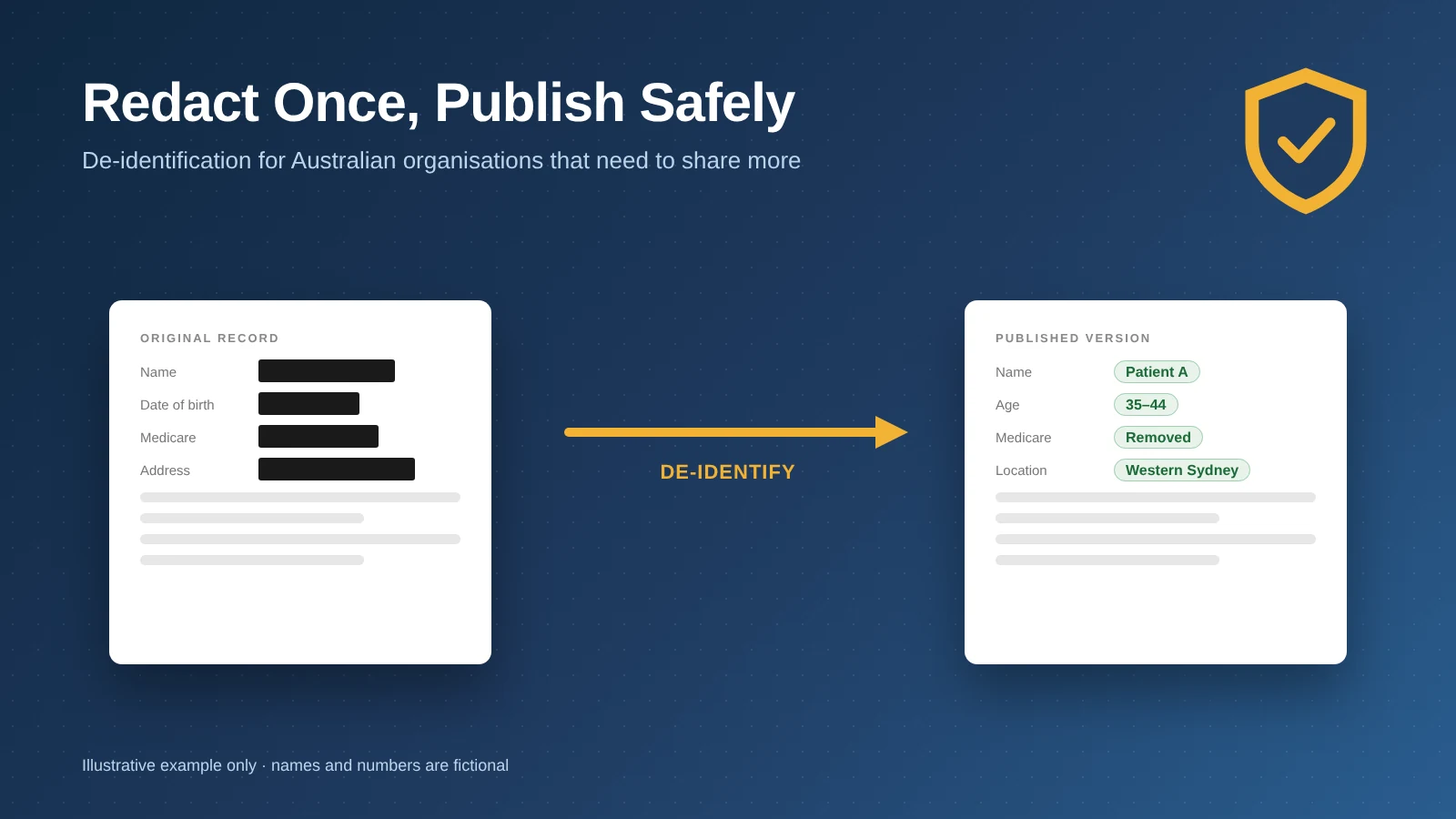
De-identification takes a broader approach. Its objective is to make individuals no longer identifiable or reasonably identifiable from the information. This may involve removing direct identifiers, replacing names with consistent pseudonyms, generalising dates or locations, or applying additional safeguards.
A name might become a pseudonym so the reader can still follow who did what. A date of birth might become an age bracket. An exact address might become a broader geographic region. A clinical note might retain its medical content while removing details that could identify the patient.
Importantly, replacing names alone does not necessarily mean information has been de-identified. A combination of remaining details may still identify someone.
The two approaches are related but serve different purposes. Redaction is particularly useful where a document's structure and substantive content need to be preserved, such as in response to a freedom of information request. De-identification is often used for research, datasets and reports where the value lies in information that can be analysed or shared without identifying individuals. Redaction itself can also form part of a de-identification process.
In the language of the Office of the Australian Information Commissioner (OAIC), information is de-identified when the risk of an individual being re-identified is very low in the relevant release context.
Software can support that process, but whether the necessary standard has been reached depends on the information, the intended release environment and the likelihood of re-identification.
Benefit 1: Meeting Australian privacy obligations with confidence
The Australian Privacy Principles (APPs) under the Privacy Act 1988 apply to Australian Government agencies and many private-sector organisations, including most businesses with annual turnover above $3 million and private health service providers regardless of turnover.
APP 6 regulates how personal information may be used and disclosed, generally restricting secondary uses and disclosures unless an exception applies. APP 11 requires organisations to take reasonable steps to protect personal information and, subject to statutory exceptions, destroy or de-identify it when it is no longer needed for a permitted purpose.
State and local government bodies are generally outside the Commonwealth Privacy Act, with privacy obligations varying by jurisdiction. In New South Wales, councils are covered by the Privacy and Personal Information Protection Act and relevant health privacy legislation. Victorian councils must comply with the Privacy and Data Protection Act and the Health Records Act, while Queensland councils are subject to the Information Privacy Act.
Western Australia's Privacy and Responsible Information Sharing Act 2024 now also applies to local governments, with its main privacy provisions commencing on 1 July 2026. Other jurisdictions have distinct arrangements, including South Australia, where the state government's Information Privacy Principles Instruction does not automatically apply to local councils.
Public release warrants particular scrutiny because information published online may become widely accessible, remain available indefinitely and be combined with other publicly available datasets.
Information that has been effectively de-identified, assessed against its intended release context, is generally no longer personal information under the Privacy Act. This can enable wider use and sharing, although other legal, contractual or ethical restrictions may still apply.
Redaction supports a different but related decision. In a freedom of information process, an authorised decision-maker determines what information can lawfully be disclosed and what must or may be withheld. Redaction then enables the selected information to be removed from the released copy.
In both cases, software can support a more consistent and repeatable process. It can identify potential personal information, apply defined detection rules and present findings for review. The organisation remains responsible for determining whether the resulting document or dataset is appropriate for release.
Benefit 2: Unlocking information for research, FOI and public reporting
One of the biggest costs of slow or unreliable redaction is not necessarily a privacy breach. It is the information that never gets released because nobody has the time or confidence to prepare it.
Freedom of information teams work to statutory deadlines. Under the Commonwealth FOI Act and Victoria's equivalent legislation, the standard decision period is 30 calendar days, subject to permitted extensions. In New South Wales, the standard period for a formal access application is 20 working days, also subject to extensions.
Reading every page of a large file for names, addresses and identifiers consumes time within those deadlines. Researchers may wait for extracts that must first be de-identified. Organisations may delay publishing reports and registers because preparing them for release requires substantial effort.
Software-assisted redaction and de-identification can change that calculation. When software identifies potential personal information, reviewers can spend more time assessing findings and ambiguous cases rather than searching manually for every identifier.
The significance extends beyond administrative efficiency.
Under section 22 of the Commonwealth Freedom of Information Act 1982 and section 25 of Victoria's equivalent Act, agencies may be required to provide edited copies of documents containing exempt or irrelevant information where specified statutory conditions are satisfied.
Victoria's Office of the Victorian Information Commissioner (OVIC) explains in its section 25 guidelines that determining whether editing is practicable involves considering the effort and resources required, as well as whether the remaining document retains meaning.
This creates an important connection between the practical work of redaction and access to information.
Reducing the effort required to prepare edited documents can help make partial access to government information practicable.
Consider a council processing a planning file. Some personal contact details may be appropriate for removal, while property addresses and other contextual information may be necessary to understand the decision. Effective redaction helps preserve relevant information while removing material that the applicable legal assessment determines should be withheld.
A research dataset may retain age brackets and broader geographic regions instead of exact dates of birth and addresses, provided the resulting information has been assessed for re-identification risk. A regulator may publish enforcement outcomes with complainants' identifying details removed, allowing the public to understand the regulator's actions without unnecessarily exposing individuals.
Faster processing is only part of the benefit. The larger gain is making more useful information available, in a form that protects privacy and makes clear what has been withheld and why.
Benefit 3: Reducing disclosure risk and building public trust
Australians have become acutely aware of what happens when personal information is exposed.
The 2022 Medibank breach involved personal information relating to approximately 9.7 million current and former customers, including health claims information for hundreds of thousands of people. The Optus breach exposed personal information relating to millions of customers, including identity-document numbers for more than two million people.
These incidents demonstrate the potential consequences of organisations holding large volumes of identifiable information.
Australia's privacy penalties have also increased significantly since those breaches, through amendments in 2022 and 2024. Under section 13G of the Privacy Act, the maximum civil penalty for a serious interference with privacy by a body corporate is the greatest of $50 million, three times the attributable benefit obtained, or, where that benefit cannot be determined, 30 per cent of adjusted turnover over the relevant statutory period.
Reducing the amount of personal information in released documents and shared datasets can limit the consequences of their subsequent exposure.
Proper redaction prevents removed content from being recovered from the released copy. Effective de-identification reduces the likelihood that individuals can be identified from the remaining information.
A compromised website, misconfigured search index or publicly scraped document archive presents a different level of risk when the published material contains less identifiable information.
Neither approach eliminates all privacy risk or replaces the need to secure original records. Organisations must continue to protect the identifiable information they retain in their internal systems.
There is also a reputational benefit.
The OAIC's 2026 Australian Community Attitudes to Privacy Survey found that 93 per cent of Australians consider protecting their personal information important, yet only 24 per cent believe most organisations are transparent about how they use it.
More than two-thirds (68 per cent) said they would be more likely to use digital services requiring personal information if they believed their data was handled fairly and responsibly.
Organisations that can demonstrate how they protect personal information while enabling appropriate access to information have an opportunity to build that trust.
Benefit 4: Speed, consistency and human review
Manual redaction relies heavily on the attention and judgement of the person reviewing a document.
Two officers may identify different information for removal, and even an experienced reviewer can overlook an identifier buried deep in a lengthy file.
Software offers a more systematic approach. The same detection rules can be applied across documents, reducing the need to locate every obvious identifier manually.
This can provide three practical benefits.
First, reviewers can concentrate on the harder cases rather than spending all their time searching for names, contact details and standard identifiers. Depending on document complexity and detection accuracy, this can improve processing efficiency without removing human oversight.
Second, organisations can establish consistent detection profiles and configurable filters, allowing teams to apply agreed identification criteria across different documents and workflows.
Third, the reviewer retains responsibility for the final decisions. Software can propose what should be examined, but a person must assess whether information should be retained, removed or treated differently.
Software also has limitations, and a reliable process must account for them.
Detection accuracy varies with the quality and format of the source material. Some tools use optical character recognition (OCR) to identify text within scanned documents and images, but not all do, so check what your tool covers. Even with OCR, image quality, handwriting, unusual layouts and embedded graphics may still require manual review.
Indirect identifiers also remain challenging. A job title, unusual medical condition, rare event or combination of apparently harmless details may identify someone even where no name or address appears.
A complete process therefore requires more than accepting the software's findings. Reviewers must consider what was missed, what the remaining context reveals and whether the resulting file contains recoverable information.
Where supported, audit logs and recorded review actions can also help organisations demonstrate how decisions were made.
Before release, the final document should be reopened and checked against the organisation's quality assurance requirements, including appropriate checks for hidden content and unintended disclosure.
The strongest approach combines repeatable technical processes with informed human review.
Using Deidentified
In the Deidentified portal, document redaction supports PDF and Word (.docx) files, with the file size limit set for each organisation. It scans document text for review; text within images is not automatically detected. Scanned pages, handwritten content, signatures and logos require manual inspection and area redaction.
Document redaction is an optional add-on, separate from tagged deidentification. It permanently removes selected content rather than replacing it with reversible tags. See the document redaction workflow and redaction add-on pricing for the supported capabilities.
Getting it right: The re-identification risk
Neither redaction nor de-identification is a one-off tick box.
The De-identification Decision-Making Framework, published by the OAIC and CSIRO's Data61 in 2017, explains why removing direct identifiers is rarely sufficient.
A small town, an unusual occupation and a particular date can identify an individual as effectively as a name. Information released publicly may also be combined with other sources, changing the likelihood of re-identification.
The OAIC notes that some material in the original framework may now be outdated. More recent guidance, including the Guide to Getting started with Anonymisation published by Asia Pacific privacy authorities in August 2025, provides an updated approach to assessing and managing anonymisation risks.
Good practice involves several principles:
- Treat de-identification as a risk assessment, not a word search. Consider who might be able to identify someone and what other information could be combined with the material.
- Choose the treatment that fits the release. Generalising ages or locations may preserve analytical value in datasets, while targeted redaction may be more appropriate for individual documents.
- Assess the remaining context. Removing names and addresses is not enough if a person's identity can still be inferred from other details.
- Keep people responsible for the decisions. Software can identify potential risks, but reviewers must determine what is appropriate for the intended use and release environment.
- Review risks over time. Information that presented a low risk of re-identification when first released may become more identifying if other relevant information becomes available.
- Be transparent about what has been removed and why. Explaining the basis for redactions or de-identification can help readers interpret released material and understand the organisation's approach.
The objective is to reduce re-identification risk to an appropriately low level in the relevant context, while preserving as much useful information as reasonably possible.
For public release of complex or highly detailed datasets, specialist assessment may be necessary.
Conclusion
Australia is asking its institutions to be more open and more careful at the same time.
Redaction and de-identification, done properly, can help organisations meet both expectations.
Effective de-identification can make information available for research, analysis and reporting without unnecessarily exposing the people represented in it. Reliable redaction can help FOI teams provide access to relevant, non-exempt material where edited copies can lawfully and practicably be released.
Both approaches can reduce disclosure risks and make information-sharing processes more efficient and consistent.
But technology cannot determine, on its own, what should lawfully be disclosed or whether the remaining information presents an unacceptable privacy risk.
Those decisions require human judgement, clear governance and an understanding of the context in which information will be shared.
The objective is not simply to remove more information. It is to make more information safely accessible while protecting the people to whom it relates.
This article is general information only and is not legal advice.
See Deidentified in Action
🔊 Turn sound on
