Policies Aren't Enough: Why "Reasonable Steps" for AI Privacy Now Means Technical Controls
By Tim Bearup · 24 Mar 2026 · 9 min read

By Tim Bearup, CEO, Propelled Solutions (trading as Deidentified)
Researched and drafted with the assistance of AI
Across Australia, staff in councils, government agencies, and private organisations are using generative AI tools every day. They are summarising case notes, drafting reports, analysing data, and responding to enquiries. In most cases, they are doing it to work more efficiently and to deliver better outcomes. Also in most cases, this is likely being done safely and in compliance with privacy obligations. But in reality, many organisations are hoping this is the case but simply don't know.
The problem is not that staff are using AI. The problem is what happens to sensitive information when they do.
Two examples of a much bigger problem
In September 2024, the Office of the Victorian Information Commissioner (OVIC) published an investigation into the use of ChatGPT by a child protection worker at the Victorian Department of Families, Fairness and Housing. The worker had entered names, risk assessments, and other sensitive personal information into ChatGPT while drafting a Protection Application.
OVIC's Deputy Commissioner found that the department contravened Information Privacy Principles (IPP) 3.1 and 4.1 by failing to take reasonable steps to ensure the accuracy of personal information and to protect it from unauthorised disclosure. A compliance notice was issued requiring six specific remedial actions.
In October 2025, ABC News reported that a contractor working on the NSW Resilient Homes Program had uploaded a spreadsheet containing the personal details of up to 3,000 Northern Rivers flood victims into ChatGPT. Names, addresses, email addresses, phone numbers, and other personal information were exposed. The NSW Reconstruction Authority confirmed the breach had occurred.
These are not isolated incidents. They are two visible examples of a pattern that is playing out quietly in organisations of every size, across every sector. Staff are using AI tools because the tools are genuinely useful. But when sensitive data is pasted into a public AI platform, the organisation loses control of that information, and with it, its ability to meet its privacy obligations.
What the regulators actually found
The OVIC investigation is particularly instructive because it spells out exactly where the failure occurred. The department had policies in place. It had guidance. But the Deputy Commissioner concluded that the controls were "insufficient to manage the risks associated with the use of GenAI tools."
The two IPPs that were breached deserve close attention.
IPP 3.1 requires organisations to take reasonable steps to ensure that personal information they collect, use, or disclose is accurate, complete, and up to date. When a staff member pastes case information into an AI tool and uses the output in an official report, the organisation is responsible for the accuracy of that output. In this case, the AI-generated content contained errors that had real consequences for a child's welfare.
IPP 4.1 requires organisations to take reasonable steps to protect personal information from unauthorised disclosure. Entering personal information into a commercial AI platform operated by an overseas company is, in the regulator's view, an unauthorised disclosure. The information left the organisation's control the moment it was pasted into the chat window.
For organisations covered by the federal Privacy Act (which includes most private sector entities and Commonwealth agencies), Australian Privacy Principle 11 (APP 11) imposes a parallel obligation: take reasonable steps to protect personal information from misuse, interference, loss, and unauthorised access, modification, or disclosure.
The critical question, for every organisation, is: what counts as "reasonable steps"?
The OAIC has now made it explicit
In late 2025, the Office of the Australian Information Commissioner (OAIC) updated the Australian Privacy Principles Guidelines for Chapters 1, 8, and 11 to reflect the amendments introduced by the Privacy and Other Legislation Amendment Act 2024.
The updated Chapter 11 guidelines now state plainly:
"Reasonable steps include technical and organisational measures."
This single sentence changes the compliance conversation. It means that organisational measures alone (policies, acceptable use agreements, staff training) are not sufficient to satisfy the "reasonable steps" test. Technical measures are now explicitly part of the standard.
The OAIC's earlier guidance on privacy and the use of commercially available AI products (October 2024) had already flagged the risks. It advised organisations to consider their APP 11 obligations when selecting AI tools, to assess whether personal information could be inputted, and to evaluate the security measures in place. The updated Chapter 11 guidelines go further: they establish technical controls as a component of what "reasonable steps" actually means.
The hierarchy of control: where most organisations are stuck
If you have worked in workplace safety, you will recognise the concept of a hierarchy of control. The principle is simple: the most effective way to manage risk is to eliminate it at the source, and the least effective way is to rely on individuals to behave correctly every time.
The same principle applies to data loss prevention for AI.
At the bottom of the hierarchy sit training and behavioural controls. This is where an organisation relies on staff to remember not to paste sensitive data into AI tools. It depends on every person, every time, making the right decision. As the OVIC investigation demonstrated, this approach fails even in high-stakes environments with clear policies.
One step up are administrative controls: acceptable use policies, governance frameworks, and procedures. These are necessary and important. But they describe what should not happen. They do not prevent it. When a staff member is under pressure, working late, trying to meet a deadline, the policy is the first thing that gives way.
This is the zone marked on the diagram as the danger zone. It is where most Australian organisations and most local governments sit today. They have policies. They have training. And they are exposed.
Moving up the hierarchy, the risk profile changes fundamentally.
Engineering and technical controls use technology to protect information, removing the dependence on individual behaviour. Isolation ensures sensitive data never reaches the external system. Substitution replaces the risky practice with a safer alternative. And elimination removes the exposure entirely through system design.
The OVIC findings, the NSW incident, and the OAIC's updated guidance all point in the same direction: organisations need to move up this hierarchy.
Moving from the danger zone to technical protection
This is the challenge Deidentified was built to solve, and critically, it was built to solve it without blocking AI use.
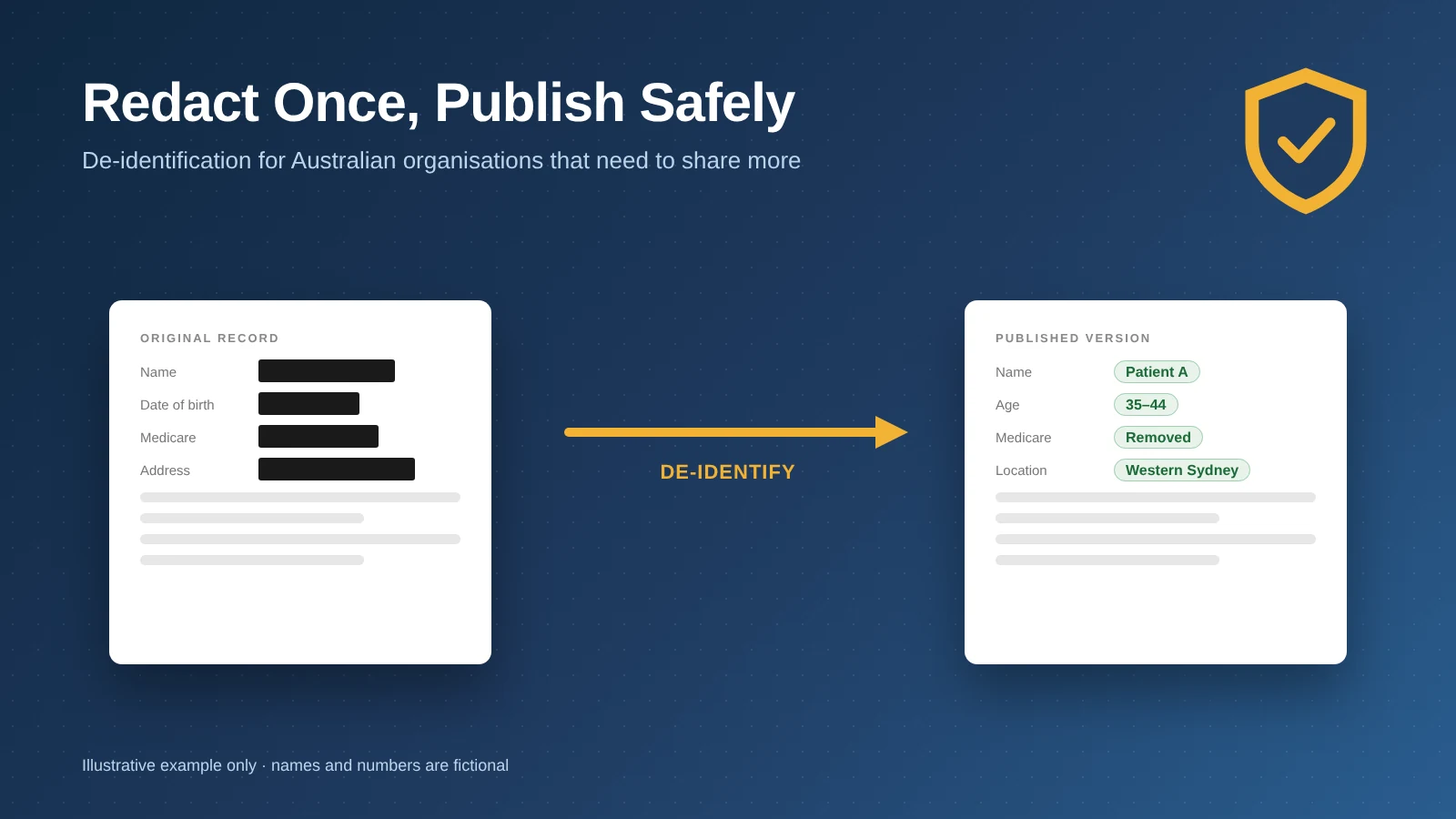
Deidentified is an AI Privacy Gateway that sits between your staff and the AI tools they use. Through its browser extension for Chrome and Edge, it enforces the removal of personally identifiable information from content before it reaches the AI platform. This is not a policy reminder. It is a technical control that operates at the point of risk, automatically, every time. Critically, though, it does not replace individual responsibility. Language is complex and de-identification is not perfect, and human review and refinement of AI outputs remains essential. Deidentified systematically removes the vast majority of sensitive information before it ever reaches the AI, presenting the de-identified content for human review so that the risk of inadvertent disclosure is substantially reduced at the source.
Here is how it maps to the hierarchy of control:
Technical controls. Deidentified automatically detects and transforms personal information, including names, addresses, case identifiers, financial details, and other sensitive information, before it leaves the organisation. Staff do not need to remember to redact. The system handles it and then requires human review.
Isolation. Sensitive data is extracted before it reaches the external AI platform. The AI receives de-identified content only. The organisation retains control of the original information at all times.
Substitution. The risky practice of pasting raw sensitive data into a public AI chat window is replaced entirely. Beyond its browser extension, Deidentified also provides a fully contained platform environment with an integrated LLM, giving organisations the option to substitute access to uncontained public AI platforms altogether. Staff still get the benefits of generative AI, with automated de-identification and human review available in the web portal. Users can bypass de-identification, for example by choosing a "No DeID" profile.
Together, these technical controls address one limb of the regulatory expectation: preventing unauthorised disclosure through system design rather than relying on individual behaviour. When paired with an organisation's existing governance frameworks, policies, and human review of AI outputs before use, they can form part of both limbs of what regulators now expect: technical measures working alongside organisational measures, not one substituting for the other.
Enable, don't restrict
There is an important nuance in the OVIC Commissioner's statement following the investigation. Sean Morrison noted that "while some uses of GenAI may be beneficial, there are currently circumstances where the privacy risks involved are simply too great." The emphasis is on managing risk, not on banning tools.
This distinction matters. Organisations that respond to AI privacy risk by blocking access entirely are solving the wrong problem. They are potentially protecting themselves from regulatory findings today, but they are also cutting their staff off from tools that genuinely improve how work gets done. Over time, that approach inhibits a culture of innovation, and in many cases, it simply pushes AI use underground into unmonitored shadow AI.
The organisations that will lead, in local government and beyond, are the ones that find the balance. They give their staff the tools to innovate while putting technical safeguards in place to meet their legal obligations. They move up the hierarchy of control, not by adding more policies or shutting down innovation, but by embedding protection into the system itself.
The regulators have made the standard clear. Reasonable steps means technical and organisational measures, not one or the other. The hierarchy of control shows the path. And the incidents in Victoria and New South Wales show what happens when organisations stay in the danger zone.
The question for every council and every organisation is straightforward: where are you on the hierarchy today, and what will it take to move up?
References
- OVIC, "OVIC finds department responsible for breaches of privacy through use of ChatGPT", Media Release, September 2024
- ABC News, "NSW flood victims' personal details loaded to ChatGPT in major data breach", October 2025
- OAIC, "Updated Australian Privacy Principles Guidelines, Chapters 1, 8 and 11", LinkedIn, December 2025
- OAIC, "Chapter 11: APP 11, Security of personal information", Australian Privacy Principles Guidelines (updated October 2025)
- OAIC, "Guidance on privacy and the use of commercially available AI products", October 2024
- Privacy and Other Legislation Amendment Act 2024 (Cth)
See Deidentified in Action
🔊 Turn sound on