A human makes the final decision. Does that mean AI is out of scope?
By Deidentified · 6 Oct 2026 · 2 min read
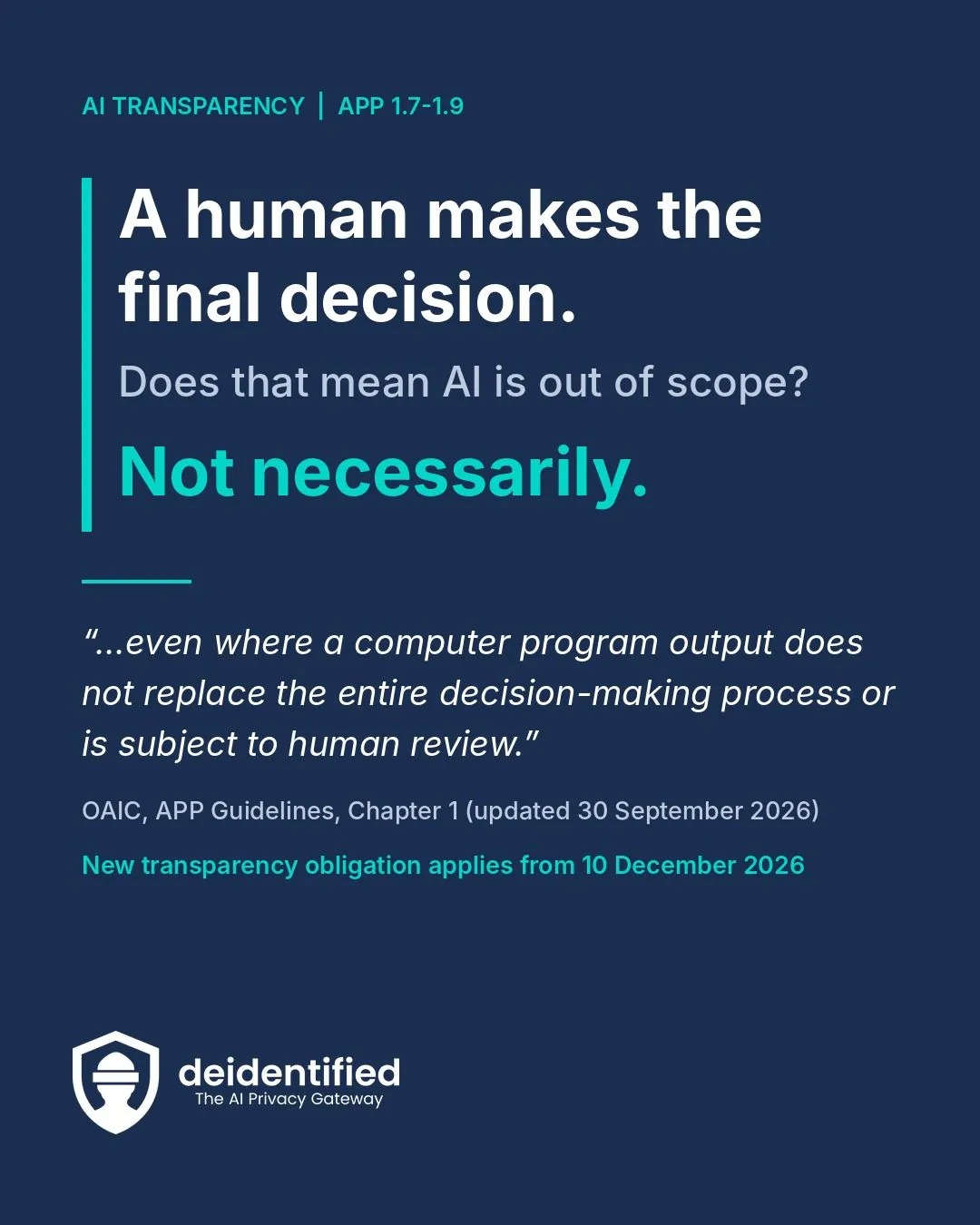
Not necessarily.
From 10 December 2026, organisations covered by the Privacy Act will have a new transparency obligation where a computer program uses personal information to make, or to do something substantially and directly related to making, a decision that could reasonably be expected to significantly affect someone's rights or interests.
The OAIC's new guidance makes two things particularly clear.
First, this is not just about "AI". "Computer program" is interpreted broadly and can include rule-based systems, AI and machine learning, generative AI, and other software.
Second, human review does not automatically take a process out of scope. A recommendation, ranking or other system output can still be a key factor in the final decision.
That changes the governance question. Instead of asking:
"Do we use AI to make decisions?"
Organisations should be asking:
"Where does technology sit in the chain of decisions about people, what personal information does it use, and how does it influence the outcome?"
For organisations directly covered by the Privacy Act, this is a new transparency requirement. For organisations operating under other privacy regimes, including many state and local government bodies, the OAIC guidance is still a useful governance benchmark. It reflects a broader expectation that organisations should understand and be able to explain how automated systems influence decisions about people.
A sensible first step is not simply to make a list of AI tools. It is to map the decision chain: the systems involved, the personal information they use, the outputs they generate, and the decisions they influence.
Source: OAIC, "New resources on transparency for use of AI and automated decision-making" (30 September 2026)
See Deidentified in Action
🔊 Turn sound on